
Attic Mold After a Michigan Winter: Causes, Signs and Fixes
Attic mold in Michigan usually starts in the middle of winter, even though most people find it in spring or during a home sale. Warm, damp air from the living space slips into a cold attic, condenses or freezes on the underside of the roof boards, and soaks the wood when it thaws. This guide explains why that happens in Ann Arbor, MI homes, what to look for, what a fix usually involves and what it tends to cost.
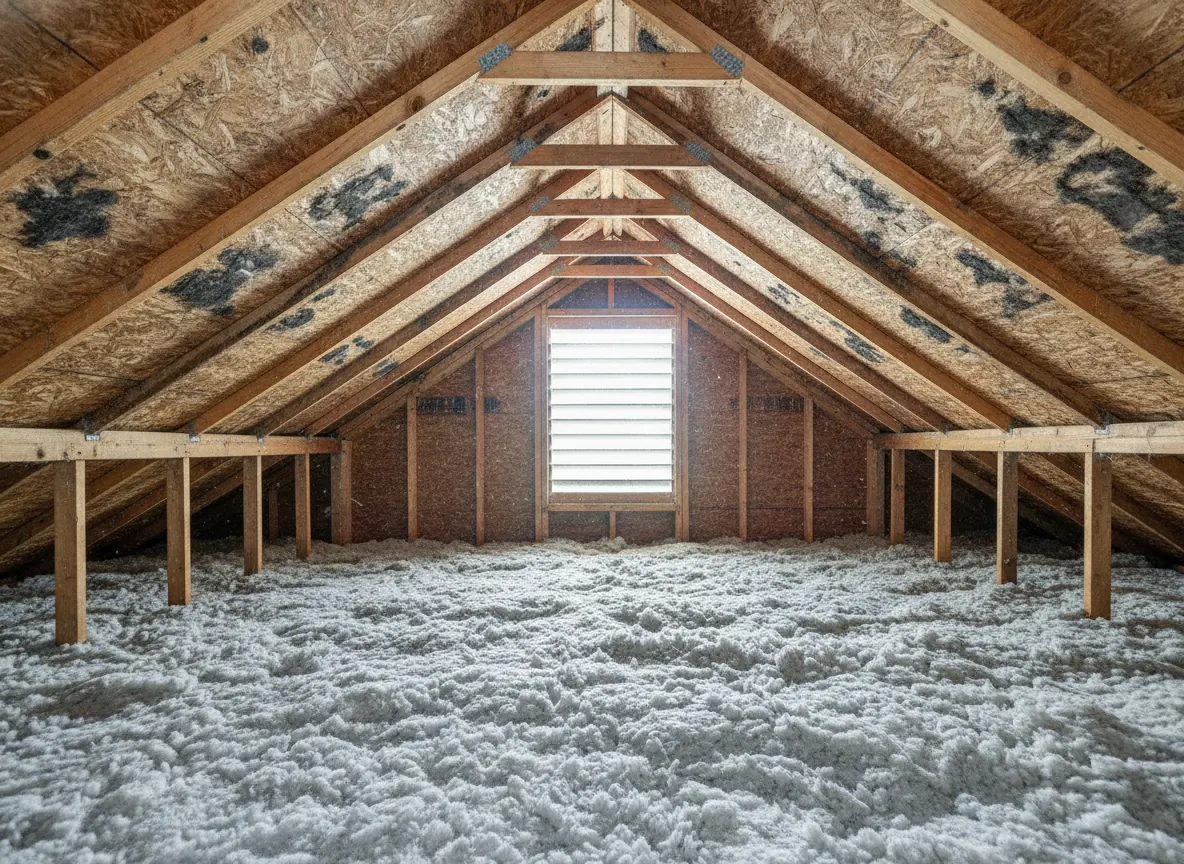
Why does attic mold form in winter?
Ann Arbor winters are long and cold. NOAA's 1991–2020 normals for the University of Michigan weather station show about 61 inches of snow a year, about 130 days with a low at or below freezing, and a January average low near 16°F. For months, the roof deck is the coldest surface in the house.
Meanwhile, the air inside holds moisture from showers, cooking, laundry, people and plants. Warm air rises, and any gap in the top-floor ceiling lets it into the attic. When that air touches roof sheathing that is well below its dew point, the water in it turns to condensation or frost. On a bitter January night you may see frost on nail tips and sheathing. When a thaw comes, the frost melts and drips into the insulation or soaks into the wood. Repeat that for a few winters and mold can grow on the sheathing, usually as gray, brown or black staining between the rafters.
Common causes in Ann Arbor homes
- Bath fans that vent into the attic. A fan that ends in the attic, or a duct that has fallen off its roof or wall cap, pumps shower steam straight onto cold wood.
- Air leaks through the ceiling. Gaps around recessed lights, the attic hatch, plumbing vent pipes, chimneys and wiring holes let warm air rise into the attic all winter.
- Blocked or missing ventilation. Insulation pushed against the soffit vents, painted-over vents, or an older roof with little ventilation leaves damp air with nowhere to go.
- Ice dams. Heat leaking into the attic melts snow on the roof. The water refreezes at the cold eaves and can back up under the shingles, wetting the sheathing and insulation near the edges.
- Roof and flashing leaks. A slow leak around a chimney, skylight or vent pipe can feed mold in one spot for years.
- High indoor humidity. A whole-house humidifier set high, or a dryer or kitchen exhaust that dumps air into the attic, adds to the load.
Older houses can be more prone to some of these problems. Census figures (ACS 2020–2024) put Ann Arbor's median year built at 1971, with about 15% of housing built before 1940. In Chelsea, about 31.8% of homes were built before 1940. Many older homes have been insulated and remodeled over the decades, and every new ceiling light or bath fan is another chance for a leak into the attic.
Signs of mold in your attic
| What you see or smell | What it can mean |
|---|---|
| Dark staining on the roof boards between rafters | Repeated condensation; the most common attic mold pattern |
| Frost on nail tips or sheathing in January | Warm, moist air is reaching the attic right now |
| Rusty nail tips or drip marks on insulation | Frost has been melting and dripping in past winters |
| Damp, matted or stained insulation | Melting frost, an ice dam or a roof leak |
| Heavy icicles or ice ridges at the eaves | Heat loss into the attic and possible ice dams |
| Musty smell in upstairs closets or the attic hatch | Damp wood or insulation somewhere above |
Check the attic with a flashlight from the hatch or walk only on the joists. If you can't safely get up there, a mold inspection or a roofing or insulation contractor can look for you. Testing is rarely needed to confirm attic mold you can see; the mold testing guide explains when it helps.
A quick winter check. On a cold, clear morning, open the attic hatch and look at the sheathing near the bath fan and the eaves. Frost there in January is an early warning. Then make sure the bath fan really vents outdoors, and run it during and for a while after every shower.
What attic mold remediation usually involves
Find and fix the moisture source
Reroute bath fans to the outside, seal ceiling air leaks, clear or add ventilation, and repair any roof leak. Without this step, mold usually comes back.
Set up protection
The company protects the living space below, often with plastic sheeting at the hatch and filtered air movement.
Clean or treat the sheathing
Methods vary by company and by how deep the growth goes. Ask each company which method it plans to use and why.
Replace damaged materials
Wet or moldy insulation is usually removed and replaced. Rotted sheathing may need roofing work.
Confirm the result
A visual check, and sometimes a clearance test by an independent tester, before new insulation goes in.
Insulation work and roofing are both trades covered by Michigan's Maintenance & Alteration license (MCL 339.2404). If the job includes replacing insulation or sheathing and the total is $600 or more, ask who holds that license.
Michigan license check. Michigan doesn't license mold remediation companies, and the state health department doesn't certify mold remediators or testers. Repair and rebuild work of $600 or more, such as replacing drywall or insulation, generally needs a Residential Builder or Maintenance & Alteration license from LARA (MCL 339.2401–2404). Ask for the license number and verify it with LARA.
In Ann Arbor's 15 local historic districts, such as the Old West Side, exterior changes may need Historic District Commission review. If a fix calls for new roof or gable vents, ask the company or the city whether that review applies before work starts.
How much does attic mold removal cost?
Published national estimates for attic mold remediation run about $1,500 to $9,000 (Fixr, Aug 2025) and $1,000 to $4,000 (This Old House with Angi data, Mar 2026). These are not quotes. The price depends on how much sheathing is affected, whether insulation comes out, how easy the attic is to reach, and how much air sealing, venting or roof repair the job needs. See the Ann Arbor mold remediation cost guide for the full table and a calculator.
Can you clean attic mold yourself?
For areas under about 10 square feet, EPA says homeowners can often clean it themselves. Attic mold is often spread across many rafter bays, though, and attics are awkward and hot to work in, with loose insulation and nails through the roof boards. Cleaning without fixing the air leak or the bath fan only buys a winter or two. For larger areas, see the attic mold page or the overview of mold removal in Ann Arbor.
EPA notes that mold can cause allergic reactions and irritation in some people. If anyone in the home has asthma, allergies or other health concerns, talk with a doctor.
Ann Arbor Mold Experts is a free quote service in Ann Arbor, MI, not a mold company. It does not inspect, test or remove mold. Describe your situation any time; independent local companies reply on their own schedules. Some companies pay to receive requests, and none of them is affiliated with this site. Request free quotes or call (734) 888-2281.
Frequently asked questions
Is attic mold dangerous?
Attic mold is usually separated from the living space, but air from the attic can move into the house through the same gaps that let moisture up. EPA notes mold can cause allergic reactions and irritation in some people. The bigger practical issue is the moisture behind it, which can damage sheathing and insulation over time.
Can I wait until spring to deal with attic mold?
Often, yes, for staining that is not spreading quickly. Winter is a good time to find the cause, because frost shows where moist air enters. If water is dripping into insulation or onto ceilings, fix that leak sooner. Ask companies whether cold-weather access changes their schedule or price.
Will a new roof fix attic mold?
Not by itself. Most attic mold comes from moist indoor air reaching cold roof boards, not from rain. A new roof can add ventilation, but if the bath fan still vents into the attic or the ceiling still leaks air, condensation can return. Fix the moisture source along with any roof work.
Does homeowners insurance cover attic mold?
Usually only when the mold follows a covered, sudden water loss, and often with a separate cap. Condensation and long-term leaks are commonly excluded. Read your policy and call your insurer or agent. See the guide on whether insurance covers mold in Michigan for more detail.